Skip to content


Turning Your Furnace On for the First Time This Fall? What’s Normal and What Needs a Technician
You flip the thermostat to heat on the first cold evening, the furnace rumbles, and a sharp burning smell comes through the vents. That smell is almost certainly dust burning off the burners, and it should clear within the first hour or two of running. If it does not clear, or the furnace never lights, or it quits a few minutes after starting, you are looking at something else.
Those are three separate problems with three different answers. This guide covers what each one means, which checks are safe to run yourself, and the point at which continuing to cycle the furnace stops being troubleshooting and starts risking damage.
Why Does a Furnace Smell When You First Turn It On in Fall?
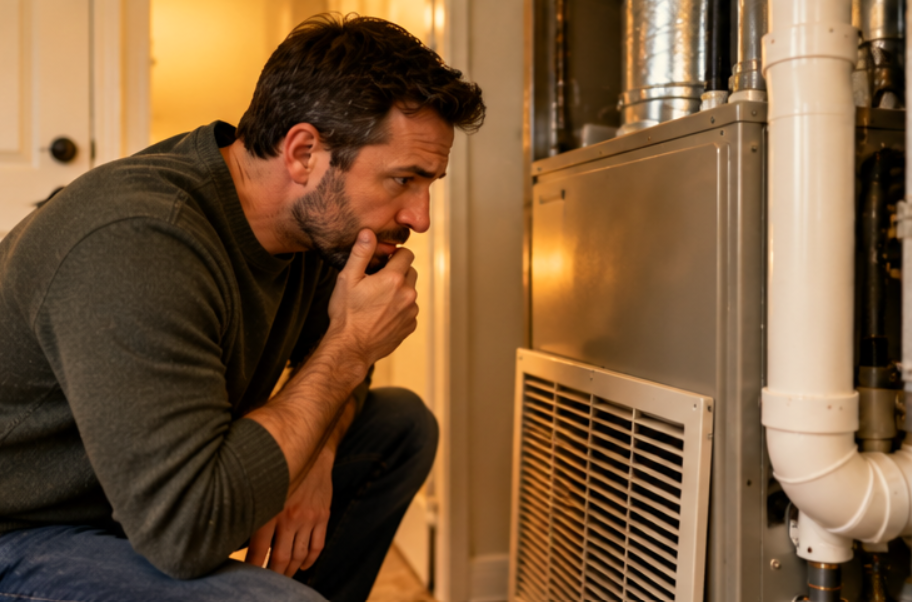
Fine dust settles on the burners and the heat exchanger across the cooling season, and the first firing scorches it off. Most residential furnaces are single stage, meaning they ignite at full output rather than ramping up, so the smell peaks within the first minute and tapers from there.
The smell is strongest after a long idle stretch. Most Cheverly homes switch the heat off in spring and back on in October, so the burners sit unused for roughly six months while dust settles on metal that has not been hot since the last cold snap.
A normal burn-off fades within the first hour or two of running and does not return on the next cycle. If the smell is gone by the time the house reaches temperature, the furnace is behaving correctly and no call is needed.
Which Furnace Smells Are Normal and Which Are Not?
Dust is the only smell on this list that resolves itself. Everything else points at a specific fault, and the response differs sharply depending on which one you are smelling.
| Smell | Likely cause | What to do |
|---|---|---|
| Dusty and burning, fades on its own | Dust burning off burners and heat exchanger | Normal, let it clear within an hour or two |
| Burning plastic or rubber | Overheating wiring or a failing blower component | Shut it off and book a technician |
| Electrical or hot metal | Shorted wiring, failing motor, overheating | Kill power at the breaker and have it inspected |
| Rotten eggs or sulfur | Gas leak, from the odorant added to natural gas | Leave without flipping switches, then call Washington Gas or 911 from outside |
| Musty or mildew | Moisture or growth in the ducts or cabinet | Not urgent, but worth addressing |
The rotten-egg row is the one that changes your behavior immediately. Washington Gas adds mercaptan to natural gas precisely so a leak is detectable, and the correct response is to leave before calling anyone, including us, and to make that call from outside.
A musty smell is a different category of problem and tends to come from the duct system rather than the furnace. Our post on HVAC smells after winter covers where that moisture usually originates and how to deal with it.
Why Won’t My Furnace Turn On After Summer?
Work the causes in the order a technician would, simplest and most accessible first. A meaningful share of no-start calls in October come down to a setting or a filter rather than a failed part.
Check the Thermostat Settings First
The thermostat has to be set to heat, with the target temperature several degrees above the current room reading, or the furnace has no reason to fire. Battery-powered thermostats go blank when the batteries die, which looks identical to a dead furnace. This costs nothing to rule out and resolves more calls than homeowners expect.
Inspect the Air Filter
A filter that ran through a DC-area cooling season can restrict airflow enough to prevent startup or trip a safety limit. If it looks gray and matted, change it before going further. Airflow faults imitate ignition faults closely enough that a dirty filter will send you down the wrong diagnostic path.
Check the Condensate Line on a High-Efficiency Furnace
Furnaces rated 90% efficiency or higher drain water through a small condensate line, often to a pump. If that line clogs or the pump fails, a float switch stops the furnace from firing so it cannot leak. Look for standing water around the base or a full pump reservoir. A blocked line is a routine fix, and a failed pump is a technician call.
Confirm Power at the Switch and Breaker
Furnaces have a service switch that looks like an ordinary light switch, usually mounted on or beside the unit, and it gets flipped off during basement work or cleaning. Confirm it is on, then check the panel for a tripped furnace breaker and reset it once. If it trips again straight away, stop resetting it, because a repeating trip means an electrical fault rather than a nuisance.
When the Igniter or Flame Sensor Has Failed
If power and settings check out but the burners never light, the hot surface igniter or the flame sensor is the usual cause. Igniters typically last four to seven years, so a twelve-year-old furnace is likely on its second or third. The flame sensor confirms a flame is present, and when it is coated the furnace lights then locks out within seconds. Both are routine furnace repair parts.
When the Gas Supply or Control Board Is at Fault
If the furnace attempts ignition and cannot complete it, the problem may sit with gas supply or the ignition control board that sequences startup. A closed gas valve or a failed board stops the burners regardless of how healthy everything else is. This is not homeowner territory, because diagnosing it means working with gas pressure and live combustion controls.
Why Does My Furnace Shut Off After a Few Minutes?
A furnace that lights, runs briefly, then quits is short cycling, and it typically shuts down within three to ten minutes. That is a safety control responding to a fault rather than a glitch, so the furnace is telling you something specific.
A Dirty Flame Sensor
The sensor has to detect the flame within a few seconds of ignition or the board shuts the gas valve. A coated sensor reads no flame even when the burners are lit, producing a furnace that fires and dies on a predictable rhythm. It is among the least costly faults on this list to correct.
A Clogged Filter Tripping the High Limit
When airflow drops, heat builds in the exchanger until the high limit switch cuts the burners. The blower usually keeps running afterward, which is a useful tell. Left alone, this cycle stresses the exchanger repeatedly, so it is worth sorting quickly rather than living with it.
An Overheating Heat Exchanger
Restricted return air, closed supply registers or a failing blower motor all drive exchanger temperatures past the design limit. This is the same mechanism as the filter problem but with a cause you cannot fix from the hallway. Repeated overheating is what eventually cracks an exchanger, which turns a repair into a replacement conversation.
A Blocked Flue or Vent
The pressure switch confirms combustion gases are leaving the building before the burners stay lit. A bird’s nest, a crushed vent pipe or snow against a sidewall termination will stop that confirmation. This one carries a combustion safety dimension, so it belongs with a technician the same day.
Cycling the furnace repeatedly to force heat out of it makes the diagnosis harder. Note how many minutes it runs before quitting and whether it happens every time, and pass that on when you call.
What Can You Safely Check Before Calling a Technician?
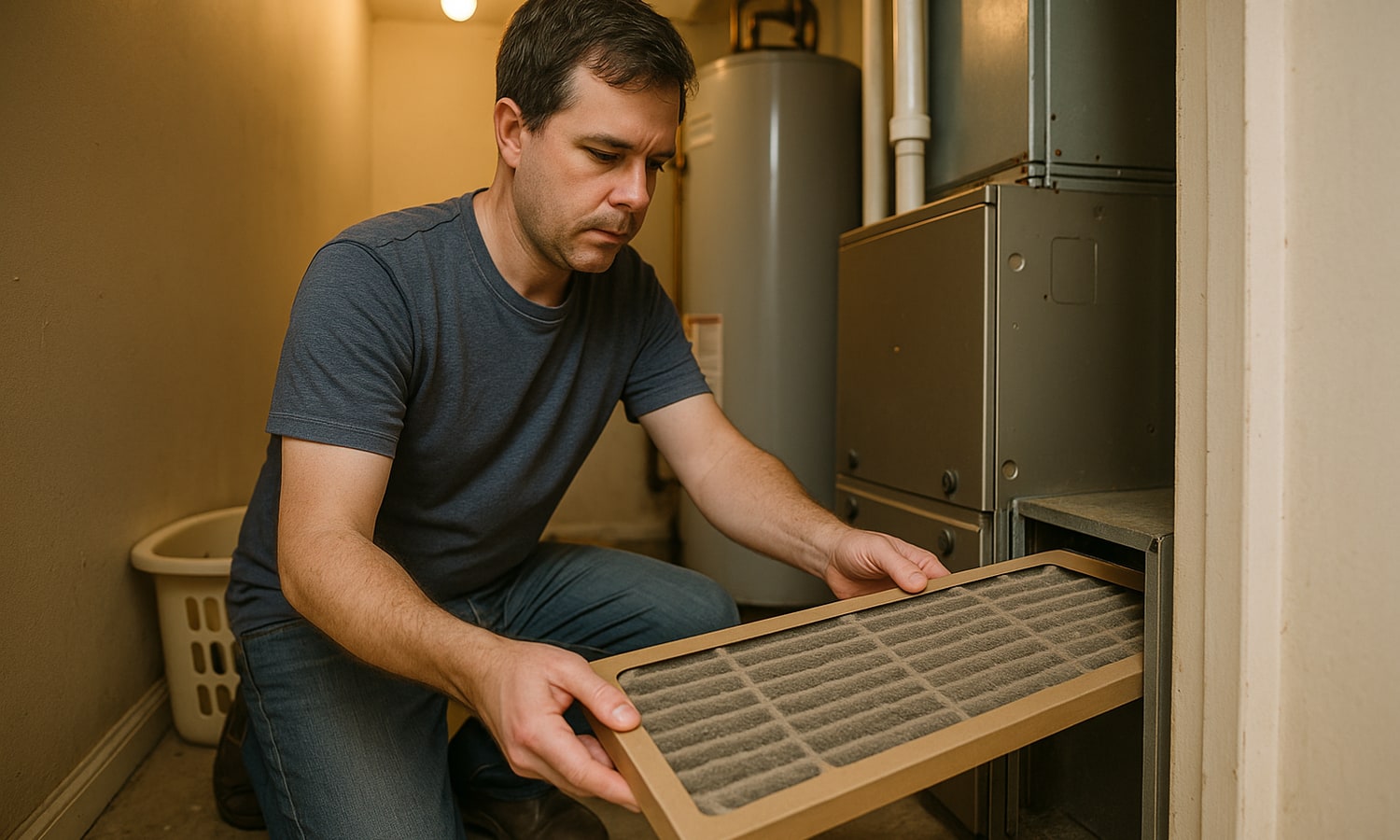
There is a firm line here. Anything involving gas, the burner assembly or the heat exchanger belongs to a technician. The checks below are safe, take a few minutes, and resolve a reasonable share of first-startup problems.
- Thermostat: set to heat, target several degrees above room temperature, batteries fresh
- Air filter: replace if gray or matted, and change it every one to three months
- Service switch and breaker: confirm the switch is on, reset a tripped breaker once only
- Furnace door panel: fully closed and latched, since an open panel trips a safety switch that stops the furnace
- Condensate drain: no standing water at the base of a high-efficiency furnace
- Vents and registers: open and unblocked throughout the house, including rooms you do not use
- Outdoor terminations: intake and exhaust pipes clear of leaves, nests and debris
If none of that restores heat, you have done the useful part. Tell the technician what you checked and exactly how the furnace behaved, because that shortens the diagnosis considerably.
When Does a Furnace Problem Need a Technician Right Away?
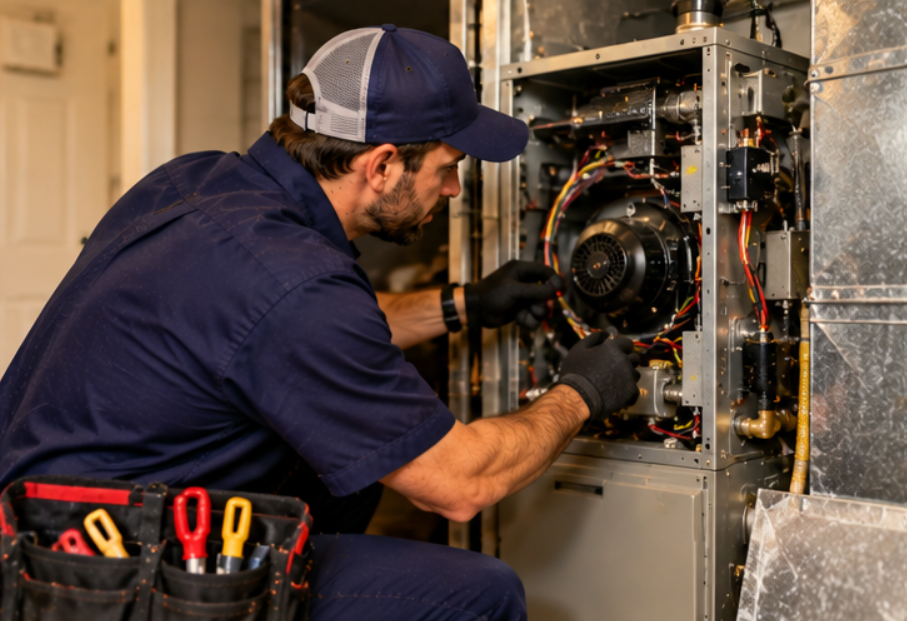
Some symptoms end the troubleshooting. A sulfur or rotten-egg smell means leave the building and call the gas utility before anyone else. A persistent burning-plastic or electrical odor, a furnace that locks out repeatedly, or a breaker that trips on every reset all indicate a fault that running the system will worsen.
A no-start on a genuinely cold night sits in its own category. The first hard cold in this market tends to arrive as a sudden snap rather than a gradual slide, and a house without heat overnight is not a wait-until-morning situation for households with infants, elderly residents or anyone with a respiratory condition. That is what our emergency heating repair service is for. When you call after hours, you reach a person on our local team, and we work to get someone out as quickly as we can.
One piece of advice we give every caller: if a technician tells you the heat exchanger is cracked, ask them to show you. A photo from an inspection camera or a combustion analyzer reading takes two minutes to produce. A cracked exchanger is a legitimate reason to replace a furnace, and it is also the easiest claim to make without evidence.
Is a Fall Tune-Up Worth It Before the First Cold Night?
A tune-up shifts the odds rather than removing risk. Parts can still fail without warning, but most of the faults in this guide show up during an inspection before they leave you without heat. A heating visit on our maintenance plan tests gas pressure, the flame sensor and the safety controls, checks the heat exchanger for cracks or corrosion, confirms the flue is drafting properly, inspects the condensate line on high-efficiency furnaces, and measures airflow and temperature rise. The plan is $150 a year and covers one heating visit and one cooling visit.
Why Choose Nero’s Heating & Air for Furnace Service in Cheverly, MD?
Our technicians work out of Cheverly, in the same housing stock and the same weather as your home. Nero’s Heating & Air holds a Master HVAC license and Maryland HVAC/R license 47671, and DC News Now has featured our winter HVAC prep tips ahead of a snowstorm.
On every furnace call, we follow the startup sequence until it stops, name the fault, and show you the repair price before any work begins. After hours, you reach someone on our local team rather than a call center, and we work to get help out to you as quickly as we can.
First-time customers receive 10% off, up to $300. If your furnace is acting up on the first cold night, or you would rather have it checked before you rely on it, call (202) 750-9543 or send us a message to book a visit.
Frequently Asked Questions
My furnace worked fine last winter. Why would it fail now?
Most first-startup failures are wear that happened before the furnace was switched off, not damage that occurred over summer. An igniter weakening last March will not announce itself until the next ignition attempt in October. Sitting idle for roughly six months also lets dust settle and moisture sit in places that matter.
Should I repair or replace a furnace that fails on the first cold night?
That depends on the part rather than the timing. An igniter, flame sensor or pressure switch on an otherwise healthy furnace is worth repairing at almost any age. A cracked heat exchanger, a failed control board on a furnace past 15 years, or a third repair in two seasons moves the arithmetic toward furnace replacement.
How fast can someone get out during the first cold snap?
Response times stretch during the first sustained cold of the season, because every deferred fault surfaces in the same week. Emergency calls are prioritized by whether the house has any heat at all and who lives there. Booking a tune-up before the first cold snap is the practical way to avoid that queue entirely.
Does a carbon monoxide detector protect me from a cracked heat exchanger?
It helps, and it is not a substitute for inspection. Detectors alarm at concentrations well below dangerous levels, but a hairline crack can leak intermittently depending on blower pressure, so a detector may stay quiet while a problem exists. Put one on every level with sleeping areas, and have the exchanger inspected annually on any furnace past ten years.
Is it worth test-running the furnace before I need it?
Yes, and it is the single most useful step in this guide. Run the heat for 15 minutes on a mild day with windows open to clear the dust smell. If it lights, holds and shuts down normally, you have confirmed the system works while technicians still have open appointments.