Skip to content


Why Is the Upstairs Cold When the Heat’s On in Your Older Cheverly Home?
In most older Cheverly homes, a cold upstairs above a comfortable downstairs is an airflow and heat-loss problem, not a furnace problem. The usual causes are restricted airflow, too few return vents upstairs, leaky or poorly insulated attic ducts, a thermostat that only reads the first floor, and a top floor that loses heat faster than the rooms below it. More than one is often at work.
Turning up the thermostat usually does not solve that imbalance. The furnace may run longer while the first floor becomes warmer, yet the upstairs rooms can remain uncomfortable if heated air is not reaching them efficiently. Understanding where the heat is being lost or restricted is the first step toward choosing a repair that actually improves comfort.
Is the Cold Upstairs a Furnace Problem or an Airflow Problem?
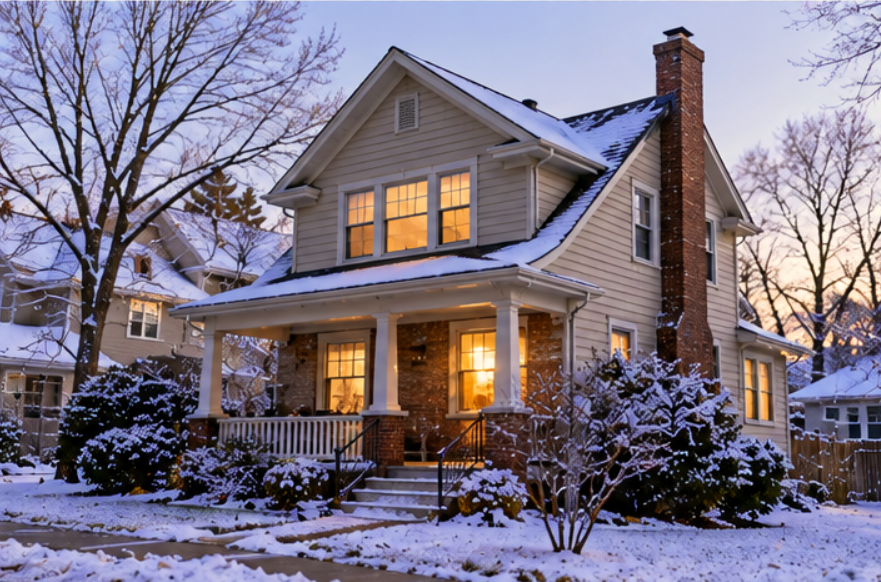
Usually airflow, and a simple test tells you which way to look. Let the system run through a full heating cycle, then compare temperatures on both floors. If the downstairs reaches the thermostat setting while the upstairs stays around 5°F or more behind, the duct system is the place to start, especially where ducts run through an unconditioned attic.
If the whole house struggles to reach the setting, the furnace itself needs testing for heating capacity, airflow and combustion. That is a different problem with a different fix, and it is worth ruling in or out before anyone talks about new equipment.
Why Do Older Homes Heat Unevenly Between Floors?
Older two-story homes in Cheverly can have heating challenges that are closely tied to how the home was originally built. Supply ducts may run through unconditioned attic areas, second-floor return capacity may be limited, and older insulation or windows can increase heat loss upstairs. These conditions can work together even when the furnace itself is operating normally.
Duct location is especially important during cold weather. When supply ducts travel through a cold attic, inadequate insulation or air leakage can reduce the amount of useful heat reaching the upstairs registers. Longer duct runs may also have greater airflow resistance, making proper duct sizing, sealing, insulation, and system balancing important parts of the evaluation.
The building itself also affects the result. An upstairs bedroom with exterior walls, older windows, limited insulation, or greater exposure to outdoor temperatures may lose heat faster than a downstairs room. That is why solving a cold upstairs often requires looking at both the HVAC distribution system and the conditions surrounding the rooms, rather than focusing on the furnace alone.
What Are the Most Common Causes of a Cold Upstairs?
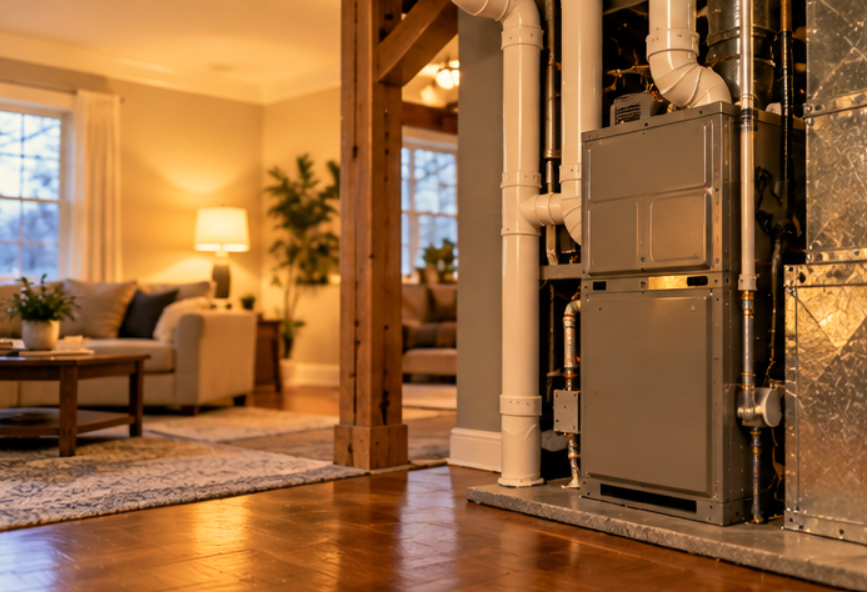
A cold second floor can result from several different airflow and building-condition problems, and more than one may be present in an older Cheverly home. Before considering equipment replacement, check the conditions that directly affect how much heated air reaches the upstairs rooms. The following are the most important areas to investigate.
Supply Ducts Running Through Cold Space
The leading cause in older homes. Supply air travels through an attic or crawlspace sitting near outdoor temperature and sheds heat the whole way. You feel it at the register as air that is moving but only lukewarm. It never fails suddenly, which is why people live with it for years. Sealing and insulating those runs is the fix.
Too Few or Undersized Return Vents Upstairs
Air cannot be pushed into a room faster than it is pulled out. Many older second floors have one small return or none at all, so supply air has nowhere to go and the floor starves. You will notice weak flow even at registers close to the air handler. Return capacity gets overlooked because everyone watches the supply side.
Unbalanced or Closed Supply Registers
Registers get nudged shut during summer and never reopened, and a damper half closed in a trunk line quietly cuts flow to an entire branch. This is the simplest cause to rule out, so check it first. Walk the house and confirm every upstairs register is fully open before assuming anything mechanical has gone wrong.
Leaky or Disconnected Duct Runs
A joint that has pulled apart in the attic dumps heated air into empty space, and a crushed or kinked flexible duct can choke flow to a whole branch. You may hear air escaping or find a register delivering almost nothing. Debris rarely blocks a run outright, but where an inspection does find buildup restricting flow, duct cleaning clears it.
A Clogged Filter Choking Airflow
A loaded filter raises resistance across the whole system, and the most distant registers lose flow first. The upstairs feels it before anywhere else, which makes this the easiest thing to rule out. Check it monthly and change it every 30 to 90 days, and keep it on the list at every seasonal heating service.
How Does One Downstairs Thermostat Leave the Second Floor Cold?
A thermostat only knows the temperature where it hangs, and in most older two-story homes that is a downstairs hallway. As the first floor reaches setpoint, the system shuts off, even though the upstairs is still several degrees behind and has not had the runtime to catch up.
The downstairs can therefore feel slightly too warm while the bedrooms stay cold. The system is obeying the only room it can read, and it is doing so correctly.
Relocating the sensor, adding a programmable thermostat that reads an upstairs remote sensor, or moving to zoning changes when the system cycles off. None of that pushes more heat through a leaking attic duct, so controls are a fix for the runtime problem rather than for the delivery problem. Sort the ducts first.
What Do Your Symptoms Point To?
Use the table below to sort what you are noticing. One symptom on its own is a starting point rather than a verdict, and two or three together usually settle it.
| What you notice | Points to airflow | Points to equipment |
|---|---|---|
| Downstairs warm, upstairs cold | Yes, duct or return issue | Unlikely |
| Whole house slow to heat | Possible, high static pressure | Yes, weak or failing furnace |
| Lukewarm air at the register | Yes, duct heat loss | Possible, burner or ignition fault |
| Loud blower, little flow | Yes, restriction or leak | Possible |
| Furnace short cycles or throws codes | Unlikely | Yes, equipment fault |
Several of these you can investigate safely. Confirm every upstairs register is fully open, check the filter, count the return vents on the second floor, and look over accessible attic duct joints for obvious gaps or crushed sections.
The line sits at anything involving the furnace cabinet, the blower, gas, or static pressure readings, which need instruments and training. If balanced registers and a fresh filter do not move the needle, a heating system evaluation with proper measurements is the next step.
What Fixes Uneven Heating Between Floors?
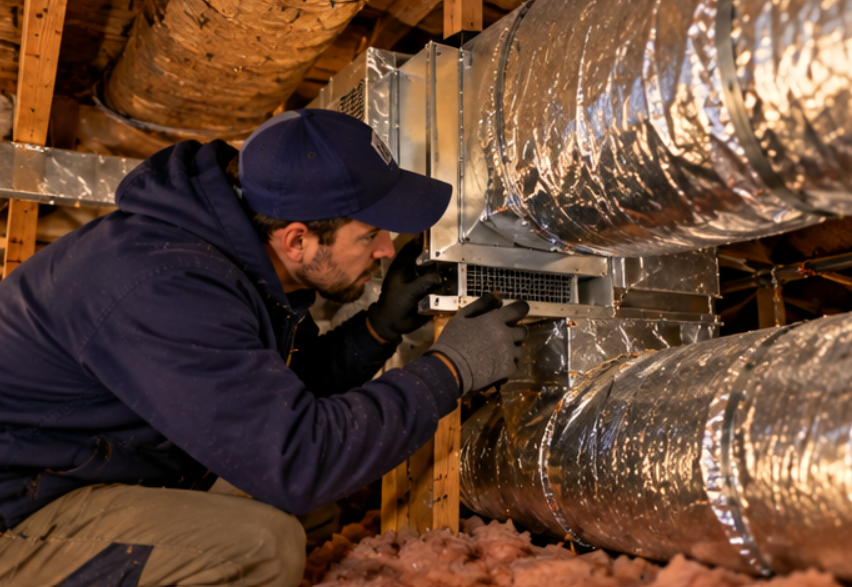
Fix airflow first, because it costs less and resolves most cases. Open and balance the registers, add or enlarge upstairs returns, then seal and insulate the attic duct runs that are bleeding heat and air.
Only once distribution is sound does equipment enter the conversation. A two-stage system runs at reduced output for longer stretches, and those gentle low-stage cycles move air to distant registers far more effectively than a single-stage furnace blasting and stopping. Variable-speed equipment goes further, holding steady airflow that reaches the farthest rooms.
Zoning with motorized dampers and a dedicated upstairs thermostat solves the runtime problem directly, because the system keeps heating until the second floor is satisfied. It is the largest investment of the three, so it belongs after duct sealing rather than instead of it.
Where a top floor or a converted attic has never been served well by the ducts, a ductless mini-split head can heat that space directly without new duct runs.
Our position on this, for anyone collecting quotes: if a contractor proposes new equipment before anyone has measured static pressure or looked in your attic, ask what they measured. The same cold rooms usually lag in summer too, and our post on keeping a finished basement comfortable covers the same distribution logic on a lower floor.
Why Choose Nero’s Heating & Air for Uneven Heating in Cheverly, MD?
Nero’s Heating & Air holds a 4.8-star rating from 200+ Google reviews, and our approach to a cold upstairs starts with measurements rather than a new furnace. Our technicians check register airflow, returns, the filter, thermostat placement and furnace performance, then explain which one is holding the second floor back.
Once the cause is clear, the fix may be a furnace or heat pump repair, a separate upstairs zone, a thermostat that reads the rooms you use, or a ductless head for a top floor the ducts never reached. You see the recommendation and the price before anything in the house is changed.
If your upstairs has stayed cold through more than one winter, call (202) 750-9543 or book an evaluation online, and we will measure what is happening on both floors.
Frequently Asked Questions
Will closing downstairs vents push more heat upstairs?
Not meaningfully, and it can raise duct pressure enough to strain the blower and shorten its life. Partially adjusting registers to balance delivery helps more than closing them off. If you are shutting several vents to force heat upward, the underlying distribution problem is worth measuring instead.
Is my furnace undersized if the upstairs never warms up?
Rarely, and almost never as the first cause. An undersized furnace struggles to heat the whole house, not one floor. A cold upstairs above a comfortable downstairs points to distribution. Capacity becomes the question only after ducts, returns and balancing have been ruled out with readings.
How much does it cost to fix uneven heating between floors?
It depends entirely on the cause, which ranges from a free register adjustment through duct sealing and an added return to full zoning. Nobody can quote this honestly over the phone. An evaluation that measures airflow turns a guess about the cause into an accurate figure for your specific house.
Why does the upstairs get cold so fast once the heat cycles off?
Heat escaping through attic ducts, thin insulation and older windows lets a second floor shed warmth quickly between cycles. Because it loses heat faster than it gains it, the upstairs never builds a baseline and each cycle starts from behind. That is an envelope issue as much as an HVAC one.
Should I insulate the attic before touching the ductwork?
Both help, and sealing the ducts usually delivers the faster result because it recovers air you are already paying to heat. If the attic insulation is thin, doing both together makes sense, since the contractor is working in the same space. Ask for the duct work to be sealed before any blown insulation buries the runs.